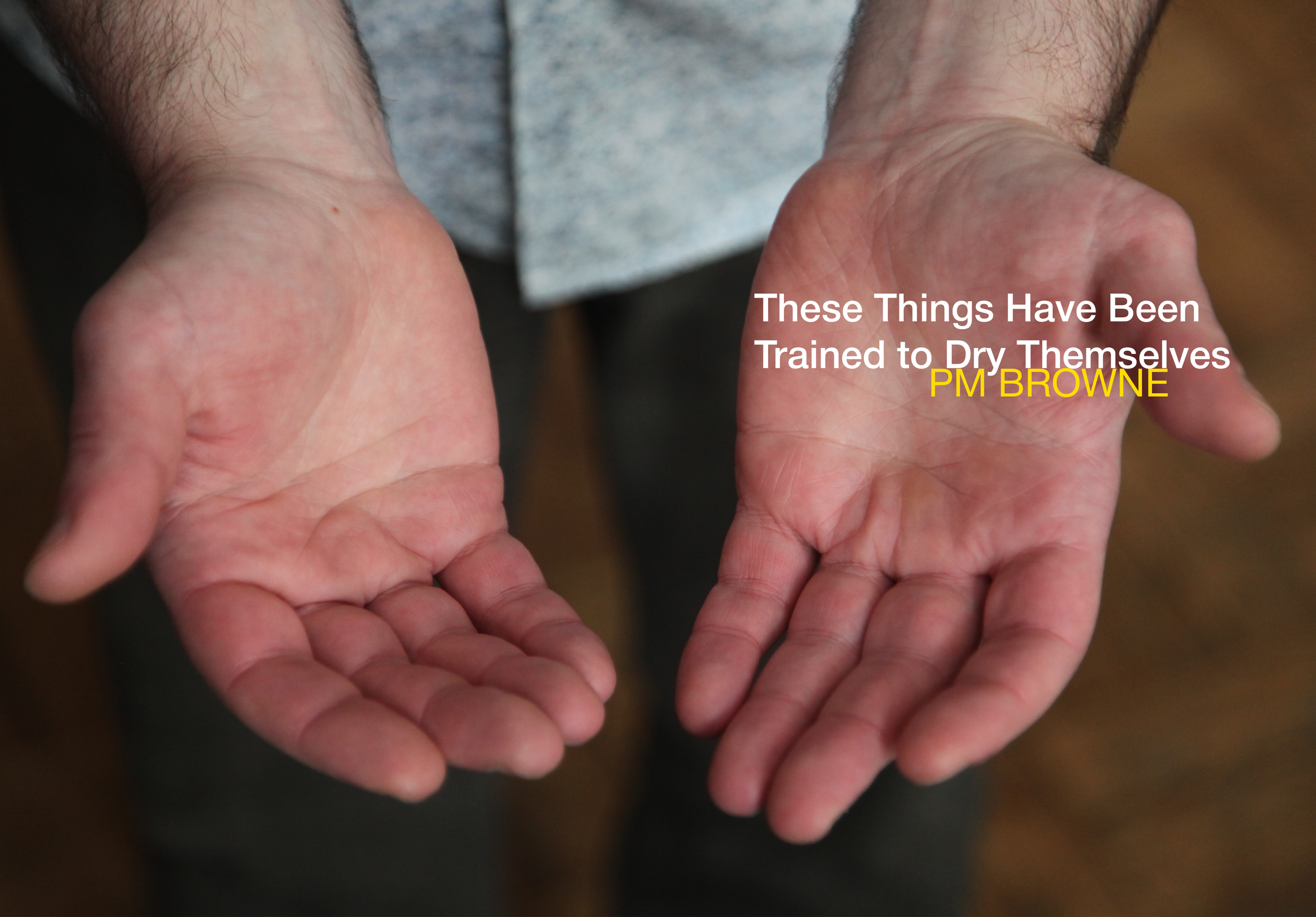
These Things Have Been Trained to Dry Themselves
“No, you must. You must have something—what do you like?”
Despite living in the area for a decade or so I barely knew anything about my neighbours save for the occasional passing politeness. Without trading names, I’d had the odd conversation with Geetha walking my bike up the steep hill whenever she happened to be at her door. She worked at the local supermarket for a time, I recalled, and had a knack of avoiding small talk. Once, she mentioned a family rift like talking about the weather and from then on I’d often find myself passing her door imploring it to open.
I decided to post a proposal letter through Geetha’s door along with a dozen others, and a few weeks went by without hearing anything back. Panting up the hill one afternoon, I decided to knock on her door impulsively and almost apologetically fell about explaining the letter when she answered. Giddy with an amused confusion at the mention of ‘art’ and ‘washing up’ put together like this, holding the proposal in her hand that she’d grabbed from somewhere just inside (which took me by surprise, thinking these letters had likely wound up in the bin), before reading it aloud as I stood at the door. Holding it closer to her face to hide her amusement here and there, she invited me in. Delighted, but unprepared, we agreed on the following day instead.
That Sunday, not really knowing what to wear, I put on a shirt and trousers and packed Marigold gloves and a scrubbing pad.
Stepping into the house and directed towards the kitchen, Geetha continued to laugh as before at the task I had willingly taken on, before observing how much hot water I was using. “I’ll have to charge you!” she said. Late afternoon, barely a handful of dirty objects sat neatly waiting to be cleaned. I shut the tap off and apologised, and became struck at just how intimate a space an unfamiliar kitchen could be. How unusual and precious the few things I was handling with great care and attention seemed to be.
Geetha spoke about her childhood in the Himalayas and took it as an insult that I had twice turned down the offer of something to drink. “No, you must. You must have something—what do you like?” she said.
Not wishing to offend, I relented, and watched as various ingredients went into the green tea. Finished with the task and removing the gloves, we sat at a narrow table pulling out two stools neatly tucked underneath to maximize space in the small kitchen. In a moment of silence, we drank the delicious concoction, before Geetha began to speak forthrightly about politics and my job, home set-up and finances. Why I still rented at my age. Why I thought I’d never own a home. Why no savings. She grew quickly frustrated at my defeated answers. The first of only three neighbours to agree to the idea of my being in their kitchen like this, I wondered if every interaction would prove this intimidating, before remarking that the tea was delicious.
Getting up to leave, I was proudly shown the cosy, sociable living room, with the furniture arranged for conversation over facing a TV, before being told the story behind the artwork on the hallway walls. The wallpaper had been hand-printed and imported from Holland. The carpet underneath our feet was practically new. The ornaments, now in her hands from the sideboard, where my letter still sat neatly folded, were gifts from family members she rarely saw.
“I’m happy alone,” she said finally, looking away as though not wishing to meet my gaze for the very first time. The house was as neat as a pin, I said as I left.
🍕 🍕 🍕
Unfortunately on This Occasion
The majority of my projects seem to start at the inbox and the post box. As an email could more easily be ignored, I would tell myself, surely an email followed by a letter on the doormat would signify a seriousness less easy to ignore. Through this practice, it became clear and important to acknowledge that silence was also an answer.
Over the years, rejection has simply become part of the job of being an artist. Learning to become neutral over such dependable disappointment, I came to see rejection as adding fuel to the fire of creativity. In more caustic moments, recognising the same phraseology time and again - unfortunately on this occasion - I sensed enough fuel to power the sun. Now, when any such correspondence is received, as from my enquiries to wash up at Buckingham Palace, 10 Downing Street, Bath Fire Station and others, the certainty seems almost welcome, and these acknowledgments form no small part in the process of any project.
Looking over the official guidance on How to write to The King, feeling that my dad, dead since 2019, would never forgive me, I couldn’t quite bring myself to sign off my letter with the suggested, but not obligatory, 'I have the honour to be, Sir, Your Majesty's humble and obedient servant'. The rejection here, received on heavy paper, seemed inevitable but worth a try.
At the Fire Station, the fireman holding the shabby door open with its keypress-lock, dressed in casual-but-ready uniform, maybe my own age or slightly older and with thread veins collected around his nose, mouth and eyes, expressed the look in nearly every eye I met when speaking about the project. The look almost a near panic of put-upon confusion and disbelief at what was being said, as though the words didn’t make nearly enough sense to respond to. I went on introducing the project, rambling a little and with inarticulacy, as the cold air from outside entered the little office behind, where two other firemen had stopped their conversation to listen to what was being said.
“I know it’s odd… ” I said finally.
“It’s crazy,” the fireman holding the door open said, stepping back a little with the stiffness gone suddenly but the redness in his face growing redder. “You’re going to wash up after us?”
🍕 🍕 🍕
Washing the Dishes to Wash the Dishes
In The Miracle of Mindfulness, the Vietnamese Buddhist monk Thich Nhat Hanh suggests, “There are two ways to wash the dishes. The first is to wash the dishes in order to have clean dishes and the second is to wash the dishes in order to wash the dishes” (2008: 3).
In all the properties I’ve rented, only once, in a shared house, has a dishwasher been provided. Consequently, and thankfully, this has meant that I came to enjoy the simple process of washing up. Without the need to concentrate on the task at hand, I could absorb myself in a radio programme or podcast, or allow time for the kind of organic mind wandering over a creative problem or project that isn’t necessarily presented at other times of the day.
As Thich Nhat Hanh puts it in The Miracle of Mindfulness:
If while washing dishes, we think only of the cup of tea that awaits us, thus hurrying to get the dishes out of
the way as if they were a nuisance, then we are not washing the dishes to wash the dishes. What’s more, we
are not alive during the time we are washing the dishes. In fact we are completely incapable of realizing the
miracle of life while standing at the sink. If we can’t wash the dishes, the chances are we won’t be able to
drink our tea either. While drinking the cup of tea, we will only be thinking of other things, barely aware of
the cup in our hands. Thus we are sucked away into the future—and we are incapable of actually living one
minute of life (2008:5).
I quickly came to realise that I had to do a good job. A really good job. I couldn’t bear the thought of somebody, having allowed me into their kitchen, inspecting the rack with irritation after I’d left and maybe then washing up afresh thinking negatively about the experience. I cleaned and scrubbed into a sweat with great care and attention.
Knowing that I was coming round at a particular time, I began to wonder if any of the collaborators ate something different that day, conscious of my looming presence and potentially looking over the used things and judging them. Or whether somebody had used a less-loved item from the shelf so that I wouldn’t carelessly handle or even break something precious by cloddish ham-fistedness. Some of the items in the pile would surely be imbued with invisible meaning.
Observing that certain objects “seem to carry with them a kind of magic” (Wilson, 2025) in an article in The Guardian newspaper, food writer and journalist Bee Wilson reflects upon the story of a heart-shaped cake tin she once used to bake her wedding cake. 23 years later and divorced, unable to let the seldom used (save for the occasional child’s birthday) cake tin go, Wilson writes:
I started looking for other people who had invested objects in their kitchens with strong meanings or
emotions. The more I asked around, the more I saw that feeling emotional about kitchen objects was the
rule rather than the exception, even for people who were not especially interested in cooking (2025).
🍕 🍕 🍕
The Residential Home
PMB: How many residents do you have here?
Kitchen Porter Dean: 50 … 60, I don’t know. The trolleys keep coming, that’s all I know.
Rules matter most to those who are enforcing them. Writing to residential homes across the South West, including a hundred or so proposals hand-delivered across Weston-super-Mare to save money on stamps, I’ve found there’ll almost always be somebody willing to bend or ignore the rules completely, with no discernible benefit to themselves or their role and place of work. Nothing, seemingly, but simple human curiosity. With various projects over the years, I have leant into this idiosyncrasy heavily.
Wanting to find collaborators in varied circumstances, and having previously worked in a nursing home where the tableware was practical over anything else, even faintly depressing, I realised this particular environment suited the project perfectly. Having raised enough money through crowdfunding to hire a professional photographer, I exchanged a number of positive emails with the manager and head chef of a particular home, who’d both looked over my letter, and a time was fixed upon. “We are all looking forward to it,” I was told.
Dark out, the fields blackly dark all around as we stood at the grand portico entrance underneath a heavily cobwebbed light, grappling with equipment, we rang the bell and waited. When no answer came we rang again, and once more, with a patient gap between rings.
Harassed-looking, confused as to why anyone was at the front door when the residents were being taken to bed, the head nurse answered and confirmed both the manager and head chef had left for the day. She weighed up our presence and looked over the things we were holding. With a sinking feeling, I realised I couldn’t show the email thread as my phone was so out of date many of the apps wouldn’t work for security reasons. I simply stated the two names I knew once more, confused, embarrassed in front of the photographer who’d driven us both the hour or so journey. Two other staff were now at the door also, needing the head nurse elsewhere, the door now opened fully so they could all see why she was being held up.
Driving home, I confessed this feeling to the photographer, and we speculated as to why none of the staff had been informed of our presence that evening. Whether it may have been forgetfulness or humour or something different. The photographer, smoking a vape with the window open a little, didn’t seem to care much for the answer. But I remained fascinated, recalling my time working in the home and the undisguised ill feeling amongst the staff toward one another, in stark contrast to the relative contentment of the residents. I felt it was all the photographic equipment that got us in, I said. Nobody seemed to have the head chef’s number and a message was left on the manager’s phone, but all that equipment under our arms seemed to mean something. As preposterous as our story sounded, the equipment was real. The head nurse relented with an air of resentment at the situation she found herself in, fixing me with a piercing look that spoke of the trust being placed in us. The photographer blew great clouds out the window, and I went on telling him things he already knew. About the poor, dumbfounded kitchen porter, Dean, blinking as I explained afresh what was happening around him. How many times I apologised! How many of the staff came into the kitchen to look at what was going on? The amount of washing up delivered on all those trolleys!
Pulling up at the supermarket cash machine, wanting air, I said I’d grab the fee and walk the rest of the way. The photographer didn’t argue. The cash came out with a sheen as if printed that moment. It felt awkward in my hand and I decided that it must be folded when handing it over, as though it would look better or this was the way people handed over large sums. I attempted to fold the pile but it seemed impossible to handle in some way. The passenger door still open, just managing to fold it at the last moment as I leant into the car, I lost grip of the glassy shape and like a magician’s deck of playing cards it suddenly flew everywhere, over the seats and the photographer’s lap and down into the footwell, as though I had inexplicably thrown the money at him.
🍕 🍕 🍕
The Student House
Mabel: When do you feel like an adult? Daisy: Whenever I talk about money.
I felt surprised that the layout to the house looked identical to my own student house in the same area, as though I was back after a 26 year absence and it had simply been redecorated a little. The ground floor bedroom (the largest still?) stood next to the lounge, which led into the kitchen, which led to the bathroom. This meant anyone in the house that needed the bathroom had to walk through the lounge and kitchen to get to it. I recalled that our shoddy toilet upstairs was so miniscule it didn’t have a basin, and that anyone wishing to sit couldn’t then close the door due to their knees being in the way.
An all-female student house, one of the three currently at home, sat together talking in the lounge as I entered, a long string of fairy lights switched on behind them, asked if this was a prank. Pulling bottles of red, white and rosé wine out of my bag as an offer of gratitude, I had hoped that the current offer on for the bottles at their local Tesco wouldn’t be known to them. In their celebration at this introduction, however – “shall we open them now!?” – I detected they knew exactly what the offers were.
Asked by one of the students if the amount of washing up the four girls and one boyfriend had left was OK, another called through to the kitchen, with no door between us, if I wouldn’t mind starting on the laundry afterwards. Even the low-maintenance garden out back was identical, with a crooked gate to the back alley that looked as though it wouldn’t close properly, just like our own. Everything felt familiar. Including the competitiveness of the students sat talking throughout as I worked away in the kitchen, joking and telling stories with increasing intensity and elaborate arcs, seizing upon the latest goings-on of their peers the other two hadn’t yet heard about.
The students were only in the house a few more months, it turned out, before leaving for opportunities elsewhere. Listening to them speak over the hour or so, just out of sight, but noticeably with them also in some way, as though the sound of the clattering and chinking things that I worked on on their behalf was a contribution to the hectic rhythm of their conversation. As if these sounds were interjections that fired them up like anything else chucked into the stream of stories bouncing around the room with a restless energy.
They decided against opening any of the wine just yet, as the night planned in town was big enough already. Thanking them, I headed for a local pub I liked but rarely visited a few minutes along the busy road. The sky an exhilarating bruise of reds, pinks and purples as the sun went down, I walked along in my uniform considering things and the project so far and felt something close to joy.
🍕 🍕 🍕
Enclothed Cognition
Throughout childhood, I loathed wearing a school uniform, which no doubt reflected my feelings toward school itself. The instant I arrived home I wrestled the uniform off scornfully, and changed into clothes that seemed to alter my psychological bearing entirely. This simple process of changing from one set of clothing to another seemed like an act of liberty.
I first came across the idea of clothing containing a certain power listening to a Radio Lab podcast (Placebo, 2009). Jad Abumrad, one of the hosts, said his doctor father seemed to physically change somehow when putting the white coat on, even looking taller. Asking his father whether he’d ever see patients without his white coat, Naji Abumrad answered, “I don't like to. It's almost like you're naked without it” (37:46). Helping him enter doctor mode, the episode suggests the inherent connotation and perception of the coat was perhaps more important than the intended practical cleanliness.
The term ‘enclothed cognition’ (Adam and Galinsky, 2012) was coined from research discovering that not only can clothing influence our mood, it can also have a surprising impact on our mental processes and cognitive ability. Finding in a pre-test that a lab coat is generally associated with attentiveness and carefulness, the experiment found that physically wearing a lab coat increased performance on attention-related tasks in the individuals taking part. For those not wearing a lab coat, or wearing something similar, like a painter and decorator’s white uniform, attention and performance did not increase.
The experiment suggested that not only does uniform change the perception of others, but changed the perception of ourselves and how we perform. Put simply, it was demonstrated that what we wear influences how we think, feel and act.
I knew I needed a uniform, something to associate myself with the project and the task ahead, and fell into the particular shirt and trousers worn throughout by virtue of this simply being the combination worn whilst washing the dishes for Geetha, the first kitchen visited. In fact I often found the combination impractical, but also somehow essential.
🍕 🍕 🍕
The Large Family
On a Sunday, sweating profusely from the temperature change outside to inside, even though it wasn’t especially cold out, or especially warm in the kitchen of a large family, I took in the elegant room with its tall ceiling and low lighting, alone apart from the family dog sniffing suspiciously at my feet.
Setting up a date over email via a mutual acquaintance, I had asked if any of the four teenagers in the house wished to take a photo and be part of the project. Heading down to the basement level, the mother explained that the youngest had agreed to replace her brother, who’d backed out shyly at the last minute. I wasn’t quite able to take this information in alongside introducing myself and speaking about the project whilst attempting to give a good impression. Talking over who we knew mutually and the strangeness of the idea and things in a sort of rush, I said ‘he’ referring to the daughter more than once, until the mother gave up correcting this and left to fetch Olive in what seemed a moment of exasperation.
I felt manic and shy myself and the sweat poured down. Dazed at the surroundings and somewhat surprised at the sheer volume of things to be cleaned, I emptied my bag of the Marigolds, cleaning pad and disposable film camera, regretting not packing a tea towel to deal with the sweat if nothing else.
A train went by and I realised how close we were to the local station, before a larger train went in the opposite direction either to or from Paddington. Losing interest, the dog headed out. Embarrassed at how I must’ve looked, I reeled around opening drawers and cupboards in search of a tea towel in a desperate mood, straining to hear anyone coming, appreciating how this would look to any of the family entering the kitchen at that moment. I found a pile of tea towels stacked neatly, and wiped my head with relief on the coarse material as someone walked in.
Laughing sweetly at this sight, Olive picked up the camera and turned it over curiously in her hands. “You want me to use this?”
“Yes please,” I said with a sort of apology feeling completely drained, and asked if she’d ever seen a disposable camera before.
“No,” Olive said taking in the sticker instructions, “but it’s obvious, I guess”. Seeming to have grasped my awkwardness in the house, and as though wishing to graciously put me at ease, she announced, “My dad used as much stuff as he possibly could today. Way more than usual. More than we could fit in the dishwasher”.
Grateful and amused at the willingness to give such information, I asked if she could come back down in a while to take the photos, and began with the task ahead. The sound of passing trains filled the kitchen with a stirring melancholy and I began to recognise a pattern between the longer and shorter carriages and the likely destination of each. The dog came in and left again, before following the dad back in as if to gauge his reaction to what was going on. I introduced myself, and pulling a beer from the fridge, he admitted that knowing I was coming round, he’d decided to really go to town over a lavish Sunday roast “with all the trimmings,” pulling things from the cupboards that hadn’t seen action for months.
A freight train went by, unmistakably. “Olive confessed the same thing earlier,” I said, speaking a little above this sound.
🍕 🍕 🍕
The Strength of Weak Ties
Close friends apart, the thought of speaking about an idea to people before any work had been produced was anathema to me. I had long been of the opinion that I should never speak about ideas for artworks, only finished ‘products’. But here, attempting to get people involved, I had no choice. It was through this openness, printing and handing out proposals to colleagues and acquaintances, complete strangers, that I was given a contact at Braziers Park Commune, near Oxfordshire.
The commune received my printed proposal, and passed it one to another around a ‘heart’ meeting. It was agreed that the proposal should be taken to the next stage; the ‘head’ meeting, two days later. Only then, once the heart and the head agreed, could I be invited into the commune. Tom Forrest, a member of the commune, contacted me after a week or so to say both meetings had been successful.
It was at this moment I felt the project come alive.
American sociologist Mark Sanford Granovetter (1973), proposed that casual acquaintances provide greater social mobility and opportunity than close friends.
Using a scale defining strong ties as a combination of emotional intensity, intimacy, mutual confiding and reciprocity that involve larger time commitments, weak ties as casual acquaintances, and absent ties as any tie without substantial significance, such as a ‘nodding’ relationship between people living on the same street, Granovetter’s central insight, according to British writer on human behaviour Ian Leslie, was that for new information and ideas, weak ties are more important to us than strong ones. Referring to a survey of 282 Boston-based workers, Granovetter:
found that most of them got their jobs through someone they knew. But only a minority got the job through
a close friend; 84% got their job through those weak-tie relationships – meaning casual contacts whom they
saw only occasionally. As Granovetter pointed out, the people whom you spend a lot of time with swim in
the same pool of information as you do. We depend on friendly outsiders to bring us news of opportunities
from beyond our immediate circles – and so the more of those acquaintances we have, the better (2020).
The hypothesis is made plausible also by empirical evidence that the stronger the tie connecting two people, the more similar they are. This being the first ongoing project I openly discussed with friends, acquaintances and ‘nodding’ relationships, I found the looser connections connected me to those out of my social sphere, and propelled the project forward, not least with a demonstrable interest (not found elsewhere), but with opportunities otherwise unavailable to me.
🍕 🍕 🍕
“He’s wearing Marigolds to protect his arty hands!”
PMB: What’s the food like here?
Ryan: It’s alright. I was 6 stone when I came through those gates. They’ve fattened me up! I’ve been locked up since I was 21. Have you been to Oxford prison? Now that’s a nice kitchen.
PMB: No. How old are you now?
Ryan: 38.
PMB: How are the cells…. What are they like? I heard there was three to a cell in places.
Ryan: I’m in a cell by myself. I can’t be with others. The last person they locked me up with took one of my caps without asking. So I had to teach him a lesson. That’s not right. He should’ve woken me up and asked me first. I smoke in the cell. I smoke wherever I like. You can’t smoke in the kitchen though. Do you smoke?
PMB: Yes. Whereabouts are you from?
Ryan: Bridgy.
PMB: Bridgwater?
Ryan: Yeah. Know it?
PMB: [nodding] I lived in Weston-super-Mare for a few years.
Ryan: Oh yeah? I know people in Weston. I prefer Bridgwater. I was homeless for years. You can’t trust your neighbours when you’re homeless. I’m in jail for a reason.
Prisoner with face tattoo: How much are you being paid for this?
PMB: Nothing.
Prisoner with face tattoo: [tapping chest] So I’m earning £1 more an hour than you! Bit of a strange hobby isn’t it?
🍕 🍕 🍕
A Place for Everything, and Everything in Its Place
There seemed a distinct loneliness in Ryan’s eyes. A desperation for human connection and understanding. The first prisoner to arrive in the kitchen, before 30 or so others, he walked up to one of the two staff members and raising himself from his short stature, got in the guard’s face over something I didn’t catch. Taken aback at this immediate aggression, I wondered just what to expect over the next couple of hours. The guard seemed unmoved by what was being said, and introduced me to Ryan explaining I was here to help him. Ryan turned sharply in my direction to look me up and down before shaking my hand, shocked and instantly appeased.
Unable to bring anything into the prison, I had asked for gloves and this seemed to cause something of a sensation around the kitchen. Comments came steadily from the food preparation table opposite and here and there from someone taking something from the shelving behind my position at the double sinks. Probed as to what on earth I was doing there, I had the distinct impression that every word out of my mouth and even the tone used was being scrutinized by anyone in earshot. The sheer volume of work to get through, however, using cold water without detergent, food remnants like tar on the trays as though I’d be better off with a jackhammer, ultimately seemed to put the prisoners at ease.
It became clear this was the job with the lowest status in the kitchen.
There was more washing up than usual that day, Ryan mentioned, keeping his voice high, because someone new trying to get out of the task during the morning, had worked so slowly it caused tension among the men, so he’d been given something else to do which left Ryan by himself. I realised this was likely the source of anger with Ryan and the guard who’d found the gloves for me, sat now in the office in the middle of the kitchen, dispensing knives from a locked shadow board, and why Ryan, younger-looking than late-thirties, short and wiry, something of a moustache, seemed so instantly relieved when turning to me in my gloves.
Piles of unclean silver pots and trays and coloured implements and things were heaped to my right, spilling onto the floor. Despite the morning’s problems, comments began to be directed at Ryan over missing items on the shelves that they needed still sat in this pile, with some accusing him of standing around talking. Hearing an increasingly sweary back and forth as other prisoners decided to join in, seemingly for the hell of it, the guard came over from the office and asked Ryan to get on with it gesturing to the pile on the floor, before looking at me with a deep frustration as if to say he knew this would be a bad idea, but also to judge if everything was OK.
I shrugged and said we were fine.
“Do you want orange squash?” Ryan asked, before heading into the office to pour out two mugs. Two of the office walls were mostly made up of wired glass panels, and neither the guard, back in his seat, or Ryan said a word. Handing over a mug with Carl’s Mug written on it, Ryan gulped down his drink. “A knife went missing last week,” he said, one eye closed for a second, reacting to the rush of thickly sweet liquid, “and we went on lockdown for two days”.
Food remnants moved around the trays in the cold water without lifting as though the scrubbing pad was more evenly coating the batter or whatever it was across the surface. Ryan and I worked on silently under the single speaker playing National Prison Radio and the floor gradually cleared. The man who’d been taken off washing up duty, transferred in from a different prison, with the look of someone who worked in finance, say, or mostly behind a desk, came over more than once to wash his hands in the cold water of the sink I was using, ignoring the unused tap next to me and the casual insults coming his way from the food prepping area opposite over this morning’s behaviour. He didn’t say a word or make any eye contact, but seemed to want to goad people at the same time.
Despite the air conditioning, my shirt clung to my skin with sweat underneath the white kitchen coat. It felt incredibly hot underneath the vaulted Victorian ceiling of the large kitchen, the prison operating at near capacity, like most prisons, I was told. As though conscious of everything happening around him, Ryan came over to unblock the sink of its filthy cold water with his bare hand more than once, even though I said I could do it, splaying a blue glove between us to indicate how it would be easier for me. “It’s alright,” he said.
More things steadily came in to be cleaned and clean things were taken from the shelves, and a sense of order settled over the kitchen, until I became conscious that someone opposite, someone I hadn’t seen over the previous 90 minutes or so, with thick blond hair swept to one side, tall and handsome-looking, like a Matthew McConaughey type, stood leaning casually against the stainless steel food preparation table, watching me. In his manner, I came to realise he’d been watching me for a while, with an unmistakable look of curiosity and menace, as though figuring something out. He smiled when I looked up, and tilted his head with that blond hair to one side as if to concentrate better, but otherwise remained unmoved.
Turning my back and pretending to do something on the shelves, I noticed the office was empty. Emptying the large sanitizer, Ryan stepped over and added something not properly dry to a high shelf so clumsily it immediately fell to the floor between us with a loud, echoing clatter. The guard appeared and looked at the scene before withdrawing again. The expression on Matthew McConaughey’s face changed and he walked off and disappeared behind the large ovens to my right.
“Tiny twat,” the prisoner with the face tattoo called, cutting meat.
Asking about my life, my work, what Weston was like these days, Ryan was interrupted by a man from the Independent Monitoring Board, compiling an annual report on the prison, who asked if I wanted to go as it had been over two hours in a way that suggested it wasn’t really a question. Guiltily peeling off the now filthy white coat, I said yes, and observed an obvious disappointment with this in Ryan’s expression, who seemed to grow that bit smaller. American photographer Diane Arbus claimed the camera gave her ‘a kind of license’ (Aperture Monograph 2011-12: 1) to inveigle herself into people’s lives, admitting she was ‘kind of two-faced’ in pursuit of subject, and I wondered if with this project I wasn’t doing something similar. As with the circus performers and others, these were my own ‘freaks’, as described by Arbus. I had even contacted a circus with a proposal.
Was there something exploitative about this project? Something transgressive? Like French artist Sophie Calle peeking into the personal lives of others as a hotel chambermaid and documenting their lives.
Ryan shook my hand and thanked me a number of times with a surprisingly candid gratitude, and it crossed my mind to say I’d come back and visit maybe…. The guard came over and collected the mug I’d been using, to which, as I hung up the coat, Ryan seemed to recover from an internal brooding to his previous combative self as he called out to the guard, “Thank you, Carl”.
On the way out, with netting above our heads everywhere as though we were in a bird enclosure, the red brick of the towering walls topped with masses of spiralled barbed wire, the men out in different exercise yards on different wings, often with tops off in the baking sun and glaring over as I went by, I confessed to the IMB man escorting me out about the strange moment with Matthew McConaughey.
“He was probably figuring out how he could take advantage of the situation,” he said. “If he could take advantage of you in some way.”
“Should I come back to visit Ryan sometime?”
“I wouldn’t advise it,” he said, making sure one gate was firmly locked behind us before opening another.
🍕 🍕 🍕
The Boarding School
Up a fairly gruelling hill, the grounds with a majestic view of the city below, international students made up a big percentage of the boarding school’s 600 pupils. Putting my lanyard on at reception and explaining the project to the teacher assigned to stay with me throughout, skipping her lunchbreak in order to do so, I said I was into the final few weeks, and how, in truth, I was looking forward to hanging up the gloves.
Introduced to the kitchen staff, who, in their initial glances at my taking pictures of the cutlery station, seemed pleasantly amused at this strange exalting of the job at hand. What was the job at hand? Teachers and students came in from the dining hall and dropped their cutlery into the sink’s submerged dishwasher rack, before placing their trays with what remained onto the stainless steel shelving the kitchen staff worked behind. Disrupting what seemed the small pleasure of discarding cutlery into the sink, I apologised feeling in the way and awkward.
Something didn’t seem right, and I felt it wasn’t working. Maybe the idea had simply gone on too long?
The teacher missing her lunchbreak suggested I head into the kitchen proper the other side of the shelving, and we could maybe take some pictures there. I could leave before it got really busy, I was told, this was nothing. A few more pictures, and you could go, if you wanted? It was up to me. With the four kitchen staff, the teacher and myself in a tight space, I cleared some plates, sprayed them down and loaded the dishwasher. Pictures were taken. I could leave and it was up to me. What was the point of this exercise, I wondered? What was this idea of intervention? What was I doing in any of these kitchens…. Was this an intervention? An intervention being an intrusion, an interference … ‘disrupting daily routines’…. What right did I have to interfere? Performance art? An action?
More students and a few teachers came through and thanked us, peering through the shelves. The cutlery, running low, went through ahead of glasses and trays into the washer. Could I please keep an eye on this? “Of course, yes!” At 1:30 it would be bedlam. Did I want more photos? Not really, no.
"You've been sweating, feel free to go before it gets crazy, you've seen nothing yet! The girls wait until the last person has finished, and all leave together,” one of the kitchen staff said.
I felt the obligation of the teacher holding the camera and expressed gratitude for her patience, and we spoke about the kind of work the young art students were producing. I cleared some trays and prioritised the cutlery. What a poser I felt. In the way and redundant and ‘doing art’. The worst kind of artist poser wasting people’s time, grabbing trays for a few Insta. shots and bailing before the work had even begun. I took the gloves off.
“What was that about,” they’d surely say as I left.
I knew I couldn’t leave before the fabled onslaught began. And when it began, the floor quickly became treacherously wet. After scraping the remnants into separate bins, the clattering and piling of the dirty plates next to me grew in number and sat as though irritably waiting to be processed alongside a mountain of grey trays and stacked glasses. The “cutlery’s running low, Paul,” I was told then by the youngest member of the kitchen staff, with such angelic patience I could’ve sobbed. The sudden noise level overtook everything. Voicing their thanks to the staff, the students entered in waves before a queue formed into the dining hall.
The clamour nearly unthinkable, the camera had been abandoned by the teacher left with little choice but to pitch in. With the tempo now set by the rhythm of ceaseless movement, my presence began to make sense within the activity of the work itself, and only because of the work. Not the art or the intervention or the gallery language or anything but the onslaught of work that required quick and efficient action, required an interlocking cog in the coordinated assembly line of non-stop movement, until the dining hall with its benches either side of pushed-together tables sat empty.
It was through this effort that I felt glad. The undeniable harmony of the combined industry required no explanation to anyone, and it felt as though every personal consideration on anyone’s mind had evaporated at 1:30pm precisely, as if vaporised by the clock above our heads, as if time had no real place until it was over, where glancing at the clock now was to be surprised. It was only then that personal agony or agency or considerations of any kind could crop up, and only then with shame.
There were bits of meat on the soaked floor that hadn’t found the bin, and we stepped about with care. Thanking the teacher and retrieving the camera, I joked she would surely require a collaborator credit over anything else.
🍕 🍕 🍕
Hanging Up the Gloves
Hiring two professional photographers, I realised how positive handing over control could be. I had initially disagreed with one photographer, more used to advertising assignments, carefully arranging every item just so against the black background and asking for everything to be thoroughly dried first—until I saw the results. “It’s much harder to ‘do chaotic,’” he said, and of course he was right.
I also realised that pictures of piled washing up was maybe not that interesting after all. So I began to ask the collaborators to take any picture using their own equipment; whatever they had at hand, and send it over afterwards. I liked the idea of my presence in these kitchens ending up more like the vernacular photography found framed on the walls or on the fridge. The significance of the domestic environment as a foundation to simply exist, with its hidden rules and secret desires, even when temporary, even when there was little choice but to operate within it, became clear from the start.
I found the categorising of people into groups, like large family, the man living alone, the single mother etc. as a starting point to finding the physical variation of washing up—whatever that would look like—vanish into insignificance stepping into any kitchen, and a surprising desire to speak frankly. As though only honesty would be tolerated between their own walls, which is where I found whatever it was I was trying to do.
Of all the things I made a note of along the way, two comments, one early on and the other near the end seemed to resonate the most. I was: “Looking at the lives of others through the mundane,”- of course! I thought, adding it to the proposals from then on as if I had thought of it myself. The other, summing up my visit and finishing coffee: “It’s not about washing up, is it, it’s about conversation”.
REFERENCES

Anton Pavlovich Chekhov and Wilson, L. (1984). Three sisters : a play. New York, N.Y. (440 Park Ave. S., New York 10016): Dramatists Play Service.
Beeton, M. (1998). The Book of Household Management : Comprising Information for the mistress, Housekeeper ... East Sussex: Southover Press, p.99.Hass, R. (2024). A Sunset. [Poetry] Available at: https://www.newyorker.com/magazine/2024/09/09/a-sunset-robert-hass-poem [Accessed 25 Feb. 2026].Owen Rowlands, L. (2021). Sophie Calle and the Art of Leaving a Trace. The New Yorker. [online] 17 Nov. Available at: https://www.newyorker.com/books/under-review/sophie-calle-and-the-art-of-leaving-a-trace [Accessed 25 Feb. 2026].BIBLIOGRAPHYAdam, H. and Galinsky, A.D. (2012). Enclothed Cognition. Journal of Experimental Social Psychology, [online] 48(4), pp.918–925. DOI: https://doi.org/10.1016/j.jesp.2012.02.008.Aperture Monograph. 2011-12. Diane Arbus. New York: Aperture FoundationGranovetter, M.S. (1973). The Strength of Weak Ties. American Journal of Sociology, [online] 78(6), pp.1360–1380. Available at: https://www.cse.wustl.edu/~m.neumann/fl2017/cse316/materials/strength_of_weak_ties.pdf [Accessed 19 Dec. 2025].Leslie, I. (2020). Why your ‘weak-tie’ friendships may mean more than you think. [online] bbc.co.uk. Available at: https://www.bbc.co.uk/worklife/article/20200701-why-your-weak-tie-friendships-may-mean-more-than-you-think [Accessed 5 Jan. 2026].Nhất Hạnh, Thích (2008). The Miracle of Mindfulness: a Manual on Meditation. London: Rider, pp.3–5.Placebo, (2009). [podcast] WNYC Studios. 28 Dec. Available at: https://radiolab.org/podcast/91539-placebo [Accessed 1 Feb. 2026].Wilson, B. (2025). Death, divorce and the magic of kitchen objects. The Guardian. [online] 29 Apr. Available at: https://www.theguardian.com/food/2025/apr/29/death-divorce-loss-kitchen-objects [Accessed 1 Jan. 2026].